
My Castration
At the Crossroads of Gender and Spirituality

I hate that gender confirming surgeries are often thought of merely as plastic surgery. Yes there is an image aspect to it, as in changing something you don’t like about your body into something you do like, but that is a gross oversimplification. With gender dysphoria and gender identity, there is so much more depth and meaning to the act. Often cis folks assume that there is only one such surgery, but that is not the case.
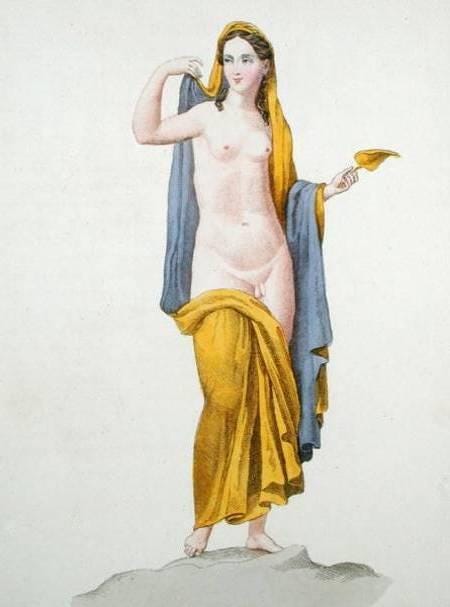
In May, 2023, after a few years of jumping through hoops, searching for in network surgeons, I was finally able to get an orchiectomy.
An orchiectomy (sometimes called an orchidectomy) is the surgical removal of the testes. It is often performed on men with with testicular cancer, much like how women with breast cancer may receive a mastectomy. One (unilateral orchiectomy) or both (bilateral orchiectomy) testes are removed in those cases. For trans women, or trans feminine non binary people, it is always a bilateral orchiectomy, but otherwise the procedure is exactly the same.
My orchiectomy was so much more to me than just the removal of a body part I didn’t want or need. There were a ton of benefits from it that made my life a lot easier, like clothes fitting better, fewer daily medications, and frankly I just hated having them. But there was also a spiritual aspect to it; for me, it was nothing less than a spiritual initiation or a religious rite.
I feel that I am now physically connected to a variety of very ancient traditions that people like me underwent thousands of years ago. Its a physical change, a physical connection that cannot be denied. For me, the Galli of ancient Rome and the Gala of Sumer all come to mind and resonate with me, although to be fair we do not know if the Gala practiced ritual castration. The Galli absolutely did.
“Over the vast main borne by swift-sailing ship, Attis, as with hasty hurried foot he reached the Phrygian wood and gained the tree-girt gloomy sanctuary of the Goddess, there roused by rabid rage and mind astray, with sharp-edged flint downwards dashed his burden of virility. Then as he felt his limbs were left without their manhood, and the fresh-spilt blood staining the soil, with bloodless hand she hastily took a tambour light to hold, your taborine, Cybele, your initiate rite, and with feeble fingers beating the hollowed bullock's back, she rose up quivering thus to chant to her companions.
“‘Haste you together, she-priests, to Cybele's dense woods, together haste, you vagrant herd of the dame Dindymene, you who inclining towards strange places as exiles, following in my footsteps, led by me, comrades, you who have faced the ravening sea and truculent main, and have castrated your bodies in your utmost hate of Venus, make glad our mistress speedily with your minds' mad wanderings.’”
From Poem 63 of The Carmina of Gaius Valerius Catullus. Translation by Leonard C. Smithers (translation 1894, poem written circa 60 BCE)
I feel more connected to my spiritual path now, more at one with myself. In a sense, the ultimate goal of my transition is to refashion my physical body into a better vessel in which to manifest my spiritual essence into the corporeal world. A seed will not grow until it is surrounded by the right soil for it flourish in; nothing will come into being unless the conditions are right for it to exist.
Since my castration, as I like to call it albeit in a somewhat tongue in cheek way, I feel much more at one with myself. More at home in my own body. It was one of the best decisions I’ve ever made for myself.